
EPSA emblem
Constitutional Framework

Statutes & Governing Bodies of EPSA

A shared foundation for student representation, ethical leadership and accountable national governance.

15 CONSTITUTIONAL ARTICLES11 EXECUTIVE PORTFOLIOSONE NATIONAL STUDENT VOICE
Consultation draft — subject to formal adoption. This proposed framework defines the NEB, NEC and NRC. Term lengths, voting thresholds and procedures are proposed rules. EPA affiliation and legal status must be supported by the relevant records and written agreement; this page does not certify recognition or ratification.

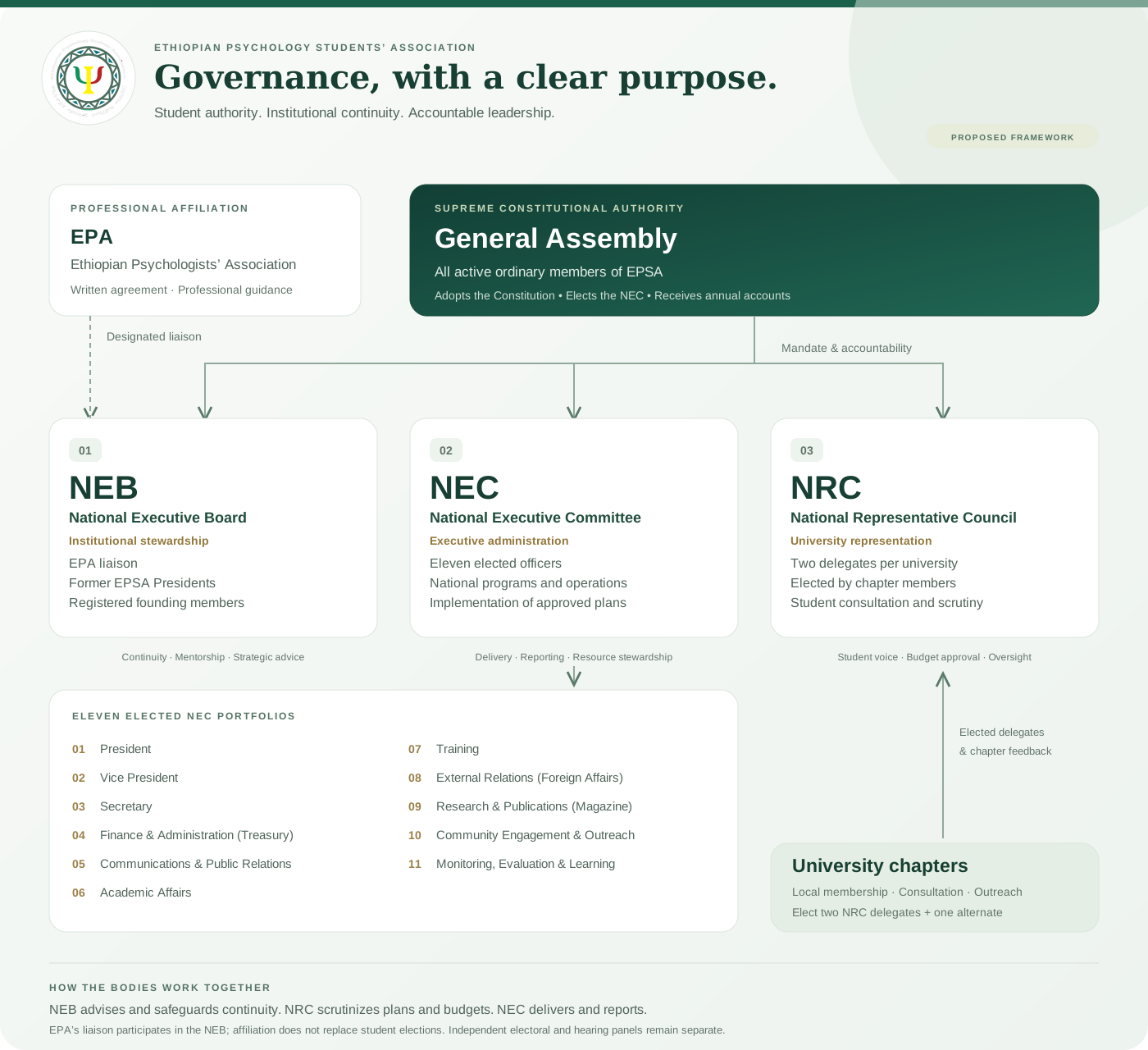
EPSA proposed organizational structure

EPSA governance: General Assembly mandates NEB, NEC and NRC. EPA designates a liaison to the NEB. University chapters elect NRC delegates. Eleven elected NEC officers deliver national programs.
Consultation draft · Subject to formal adoptionDownload organizational chart ↗
Read the eleven NEC portfolios →
Article 1

Name, Objects and Constitutional Authority

1.1

Name and character

The organization shall be known as the Ethiopian Psychology Students’ Association (EPSA or the Association). It shall be a nonprofit, nonpartisan and nonsectarian student association serving psychology students across Ethiopia. Its income and property shall be applied exclusively to its objectives and shall not be distributed for the personal benefit of members or officers.

1.2

Objects

EPSA shall advance psychology education, ethical scholarship, research literacy, student representation, professional development and public mental health awareness. It shall facilitate inter-university cooperation, academic exchange, mentorship and appropriately supervised community engagement, and advocate equitable access to opportunities for psychology students.

1.3

Distribution of authority

The General Assembly (GA) shall be the supreme constitutional body. The National Executive Board (NEB) shall provide institutional stewardship and continuity. The National Executive Committee (NEC) shall conduct executive administration. The National Representative Council (NRC) shall represent university constituencies and scrutinize executive performance. No organ shall assume powers expressly reserved to another.

1.4

Supremacy and interpretation

Applicable law shall prevail over this Constitution; this Constitution shall prevail over bylaws, policies and resolutions. A binding affiliation agreement shall be implemented within these constraints; any inconsistency shall be reconciled by lawful amendment or revision of the agreement. A simple majority means more than half of valid votes cast, excluding abstentions and blank ballots. Special-majority fractions and quorum fractions shall be rounded upward. Unless otherwise stated, days mean calendar days.

Article 2

Membership, Rights and Inclusion

2.1

Membership categories

Ordinary voting membership shall be open to verified students enrolled in recognized psychology programs in Ethiopia. Related-discipline students, alumni and supporters may be admitted as associate or honorary members under published criteria, without ordinary voting rights or NEC eligibility. Membership shall not confer professional licensure or authorization to practise psychology.

2.2

Rights of members

Every active ordinary member shall be entitled to vote, seek eligible office, submit proposals, receive timely notices, inspect nonconfidential records, question officers and receive fair treatment. Membership verification and renewal requirements shall be published and applied consistently. Inability to pay shall be addressed through a confidential dues-waiver procedure that preserves participation.

2.3

Obligations of members

Members shall uphold this Constitution, respect the dignity of others, protect confidential information, disclose relevant conflicts and use Association resources responsibly. A restriction or termination of membership shall require specified grounds, notice, a fair opportunity to respond and an independent appeal under Article XII.

2.4

Equality and accessibility

No person shall suffer discrimination on grounds of sex, gender, disability, ethnicity, language, religion, region, socioeconomic circumstances or other personal status unrelated to a legitimate eligibility requirement. EPSA shall provide reasonable accommodations, accessible documents, low-bandwidth participation and language support appropriate to its constituency. Selection criteria shall be transparent and opportunities shall be communicated across recognized chapters.

2.5

Inclusive representation

The NRC shall review participation barriers annually and recommend support for underrepresented universities and groups. Voluntary demographic information shall be aggregated and protected. Outreach targets shall not retrospectively change election results or create undisclosed candidacy restrictions. Complaints of discrimination or retaliation shall receive independent review.

Article 3

Relationship with EPA

3.1

Written affiliation

The relationship with the Ethiopian Psychologists’ Association (EPA) shall be documented in a written recognition or affiliation agreement. The instrument shall specify institutional status, permitted use of names and marks, professional support, financial arrangements, reporting, safeguarding, liability and dispute procedures. Public claims of affiliation shall reflect the agreement actually in force.

3.2

EPA liaison

EPA shall be invited to designate one liaison and one alternate in writing. The liaison shall hold one NEB seat, facilitate professional mentorship, communicate EPA guidance and relay relevant EPSA decisions to EPA. The alternate may act during absence but shall not create an additional seat or vote. EPA shall determine the duration and replacement of its designation, subject to EPSA’s conduct safeguards for board participation.

3.3

Student autonomy and professional cooperation

Student elections and ordinary EPSA administration shall remain governed by this Constitution. EPA guidance shall be considered and recorded. The liaison shall not unilaterally appoint or remove student officers, invalidate ballots or veto resolutions. Activities requiring professional supervision or institutional permission shall proceed only after the necessary arrangements are secured. EPSA membership shall not be represented as EPA professional membership.

3.4

Authority to make commitments

No EPSA officer shall bind EPA, use its funds, display its endorsement or issue a joint statement without written authorization from the competent EPA authority. Any approval required by an affiliation agreement shall be identified before the relevant commitment. The NEB shall lead documented consultation on affiliation disputes, followed by mutually agreed mediation where necessary.

Article 4

General Assembly

4.1

Composition and reserved powers

The GA shall comprise all active ordinary voting members. It shall adopt and amend the Constitution, elect NEC officers through national ballots, determine strategic policy, receive annual reports and accounts, decide reserved constitutional matters and authorize dissolution. It shall appoint the independent hearing pool and Election Appeals Panel under the procedures below.

4.2

Meetings and notice

An ordinary GA shall convene annually on at least 30 days’ notice. An extraordinary GA shall be convened within 30 days of a request by two-thirds of the NEB, two-thirds of the NRC or a verified petition of 20 percent of active members. Extraordinary notice shall provide at least 14 days and identify the business. Special amendment and dissolution notice periods shall prevail where applicable.

4.3

Quorum and voting

Quorum shall be 25 percent of active ordinary members on the notice-date register, with participation from at least half of recognized chapters. Authenticated remote and physical attendees shall count equally and each person shall count once. If quorum fails, the meeting shall be reconvened on at least 14 days’ notice with the same quorum. Ordinary decisions shall require a simple majority; special decisions shall satisfy their express thresholds. Election turnout shall be governed separately by Article IX.

4.4

Participation and records

Members shall have a reasonable opportunity to submit questions and motions. A conflicted presiding officer shall relinquish the chair for the relevant business. Approved minutes and voting totals shall be published within 14 days, excluding protected personal information. No GA resolution shall retrospectively alter electoral rules to favor a candidate.

Article 5

National Executive Board — NEB

5.1

Composition

The NEB shall consist of the EPA liaison, all verified former EPSA Presidents who accept active service, and all founding members entered in the GA-approved founding register who accept active service. Each individual shall hold one seat and one vote even where more than one category applies. NEC officers shall not acquire NEB membership merely by holding executive office.

5.2

Membership register and activation

The Secretary shall maintain documentary evidence of founding status, presidential service, EPA designation and written acceptance. The initial founding register shall be authenticated by the adopting GA. Subsequent corrections shall require evidence, member notice and a two-thirds GA vote. The NEB shall not create new founding members by co-option. Active service shall be confirmed annually; inactive historical members shall not count toward quorum.

5.3

Leadership and tenure

The active NEB shall elect a Chair and Deputy Chair for two-year terms, renewable once consecutively in the same chairing office. Eligibility arising from former-presidential or founding status shall continue subject to acceptance and conduct requirements. EPA liaison tenure shall follow EPA’s designation. The NEC President and Secretary may attend as nonvoting reporting officers except during confidential or conflicted business.

5.4

Strategic duties

The NEB shall preserve institutional memory, advise on long-term strategy, mentor successive executives and safeguard the Association’s founding purposes. It shall review major partnerships, affiliation arrangements and institutional risks, and provide written recommendations to the NEC, NRC and GA. It shall support orderly leadership transitions and preservation of institutional records.

5.5

Oversight responsibilities

The NEB shall receive quarterly executive and financial reports, assess conformity with the Constitution and GA policy, recommend independent reviews and report annually on institutional stewardship. Suspected serious misconduct or misuse of funds shall be referred to an independent process under Article XII. Board members shall exercise care, disclose conflicts, maintain confidentiality and avoid using historical status for personal advantage.

5.6

Limits on authority

The NEB shall not administer routine departmental work, replace elected officers by board appointment, amend electoral rights or spend outside approved authority. It may request reconsideration of an apparently unconstitutional decision and refer a dispute under Article XV. Advice shall be identified separately from binding resolutions within its express mandate.

5.7

Meetings and decisions

The NEB shall meet at least quarterly on seven days’ notice. Quorum shall be more than half of active unconflicted voting members, and no binding decision shall be taken by fewer than three such members. If fewer than three remain, the NEB shall act only in an advisory capacity until lawful membership is restored. Decisions shall require a simple majority; a tie shall defeat a motion. Attendance and stewardship activity shall be reported annually.

5.8

Vacancies and accountability

Historical seats shall not be inherited or transferred to nominees. EPA shall fill its liaison vacancy. Removal from active NEB service shall follow Article XII without erasing accurate historical records. A person elected to the NEC shall suspend voting NEB service for that executive term and shall be excluded from NEB quorum during that period.

Article 6

National Executive Committee — NEC

6.1

Composition

The NEC shall comprise eleven individually elected officers: President; Vice President; Secretary; Director of Finance & Administration (Treasury); Director of Communications & Public Relations; Director of Academic Affairs; Director of Training; Director of External Relations (Foreign Affairs); the elected head of the Directorate of Research and Publications (Magazine); the elected head of the Directorate of Community Engagement and Outreach; and Director of Monitoring, Evaluation and Learning. Each directorate shall have one elected head and one NEC vote; supporting volunteers shall have no additional NEC votes.

6.2

Collective mandate

The NEC shall implement GA resolutions, administer approved plans and budgets, coordinate national programs, maintain member services and submit quarterly reports to the NRC and NEB. Officers shall act in good faith, for proper purposes and with reasonable care, loyalty, confidentiality and responsible stewardship.

6.3

Plans and reporting

Within 30 days of taking office, every officer shall submit a portfolio plan identifying activities, costs, milestones, accessibility measures, risks and indicators. The NEC shall submit a consolidated annual plan for NRC approval. Each officer shall report monthly to the NEC and contribute to quarterly institutional reporting, preserving records for handover.

6.4

Meetings and delegation

The NEC shall meet monthly on at least five days’ notice. Quorum shall be six unconflicted officers. Decisions shall require a simple majority, each officer shall have one vote and ties shall defeat motions. Delegations shall be written, limited and recorded; the delegating officer shall retain accountability. No officer shall incur obligations outside the approved mandate.

6.5

Terms and incompatible offices

The term shall be one academic year from the published handover date. No person shall serve more than two consecutive NEC terms in any combination of offices. Voting NRC membership, voting NEB service and electoral administration shall be incompatible with NEC office. Portfolio volunteers shall be recruited fairly under published criteria and shall receive only the access necessary for their duties.

Article 7

National Representative Council — NRC

7.1

University representation

Each recognized university chapter shall elect two voting NRC delegates and one alternate. Each university, including its campuses, shall constitute one national constituency. Each delegate shall hold one vote; the alternate shall vote only in place of one absent or vacant delegate and shall never cast two votes. Equal representation shall not depend on chapter size or geographic location.

7.2

Recognition of chapters

A chapter shall demonstrate an eligible psychology-student constituency, open membership, elected local officers, compatible rules and any necessary university permission. The NRC shall issue a reasoned recognition decision within 30 days. Refusal may be appealed to the GA. Pending applicants may attend as nonvoting observers. Recognition shall not depend on political support for national incumbents.

7.3

Delegate elections and tenure

Delegates and the alternate shall be elected by chapter members through secret ballots for one academic year, renewable once consecutively. Each voter may select up to two different delegate candidates; the two highest totals shall win. The alternate shall be elected in a separate ballot by the highest valid total. Ties shall require runoffs. Delegates shall remain enrolled members of their represented university.

7.4

Duties of every representative

Each delegate shall consult chapter members before significant national decisions; communicate national notices within seven days; present student concerns accurately; maintain accessible feedback channels; hold an open chapter consultation at least once per academic term; and submit a quarterly constituency report. Representatives shall distinguish personal views from chapter positions, protect complainants’ identities and avoid promising outcomes beyond their authority.

7.5

Council responsibilities

The NRC shall scrutinize NEC quarterly reports, question directors, approve annual plans and budgets, review variances and require corrective plans with deadlines. It shall propose GA motions, adopt subordinate bylaws, coordinate chapter feedback and monitor equitable access to national programs. It shall not interfere with secret ballots, independent hearings or the content of legitimate research findings.

7.6

NRC officers

Delegates shall elect a Chair, Deputy Chair and Rapporteur for one year. The Chair shall convene meetings, coordinate agendas and ensure fair debate. The Deputy shall support chapter participation, monitor accessibility and act during the Chair’s absence. The Rapporteur shall record minutes, attendance, votes, resolutions and follow-up actions. Each shall retain only one delegate vote and shall have no casting vote.

7.7

Meetings and quorum

The NRC shall meet at least once per academic term and upon a request by one-third of delegates, normally on seven days’ notice. Quorum shall require more than half of filled voting seats and representation from more than half of recognized chapters. Ordinary decisions shall require a simple majority. Authenticated remote participation shall be permitted. The NEC and NEB may attend by invitation as nonvoting reporting bodies.

7.8

Recall and vacancies

A verified petition from 25 percent of active chapter members may initiate recall of a delegate. An independent chapter returning officer shall provide 14 days’ notice, an opportunity to respond and a secret ballot. Recall shall require two-thirds of valid votes and 40 percent chapter turnout. Recall is a constituency decision and shall not itself establish misconduct. The alternate shall fill a vacant delegate seat; further vacancies shall be filled by by-election within 30 days.

7.9

Chapter obligations and protection

Chapters shall maintain accurate membership records, conduct open elections, report activities and finances, observe national safeguards and consult students on national matters. A chapter shall not lose recognition solely because an officer resigns. Suspension shall require specified grounds, notice, a fair hearing and a two-thirds NRC vote, with appeal to the GA. Any interim protective measure shall comply with Article XII.

Article 8

Detailed Duties of the Eleven NEC Offices

8.1

President

The President shall provide strategic leadership, represent EPSA within approved authority, chair NEC meetings and ensure implementation of GA resolutions and NRC-approved plans. The President shall coordinate all portfolios, resolve administrative overlaps and maintain an executive action register. Quarterly reports and an annual state-of-the-Association address shall account for achievements, expenditure, risks and unfinished commitments. The President shall maintain formal working relations with the NEB Chair, NRC Chair and EPA liaison. Approved agreements shall be signed with the Secretary or another authorized officer. The President shall ensure lawful approval of liabilities and a complete handover, and shall not unilaterally dismiss elected colleagues, amend policy or control electoral administration.

8.2

Vice President

The Vice President shall coordinate implementation across portfolios, track NEC resolutions and support chapter operations. The office shall maintain a record of delegated duties, deadlines and unresolved delivery risks. The Vice President shall coordinate inclusion measures with the NRC, ensure that interdepartmental projects have accountable leads and lead operational handover planning. During a recorded absence or vacancy, the Vice President shall act as President within existing authority. Acting service shall confer no additional vote, independent term or power to alter the constitutional distribution of authority.

8.3

Secretary

The Secretary shall issue meeting notices, prepare agendas, record accurate minutes and votes, and maintain resolutions, correspondence, policies and institutional archives. The office shall maintain verified membership and officeholder registers, track constitutional deadlines and notify the competent organ of overdue duties. Election data shall be supplied only to the extent necessary for lawful voter verification. Approved nonconfidential decisions shall be published promptly. Secure backups, retention schedules and access controls shall protect institutional records. Custody shall not authorize alteration of votes, suppression of resolutions or unilateral determination of disputed eligibility.

8.4

Director of Finance & Administration (Treasury)

The Director shall prepare the consolidated budget, maintain ledgers, receipts, an asset register and cash-flow forecasts, and reconcile institutional accounts monthly. Authorized dues and donations shall be deposited promptly into approved Association accounts; personal accounts shall not hold EPSA funds. Quarterly financial reports shall disclose income, expenditure, restrictions and budget variances. The Director shall administer procurement, reimbursements, inventories and administrative arrangements; support independent examination; and track corrective actions. Request, approval and payment duties shall be separated. Undocumented payments shall be refused and suspected misuse reported. The Director shall not approve personal reimbursements without an independent authorized approval.

8.5

Director of Communications & Public Relations

The Director shall maintain official channels, implement a communications strategy and publish accurate, accessible notices. Statements shall be verified with the relevant portfolio and approvals recorded. Brand assets and public communications shall be archived. Media enquiries and crisis communications shall follow approved protocols, and material errors shall be corrected promptly. Personal stories and images shall require appropriate consent; confidential cases shall be protected. Official election communication shall give eligible candidates equal access under Commission rules, and institutional channels shall not endorse candidates.

8.6

Director of Academic Affairs

The Director shall assess academic needs across chapters and coordinate peer learning, study resources, academic forums and lawful examination-preparation initiatives. Consultation with university departments and NRC delegates shall identify resource gaps and development needs. Educational materials shall be reviewed for accuracy by suitable contributors and distinguished from official university or licensing requirements. The office shall promote academic integrity, accessibility and transparent selection for opportunities, collect feedback and report outcomes. Individual academic appeals shall be referred to the competent university; EPSA shall not claim authority over institutional assessment decisions.

8.7

Director of Training

The Director shall prepare a needs-based annual training calendar with learning objectives, budgets, facilitator criteria and evaluation methods. Facilitators’ qualifications and any required supervision shall be verified before delivery. Participation criteria shall be fair, venues and digital delivery accessible, and safeguarding arrangements documented. Attendance and completion records shall support accurate certificates. No certificate shall imply licensure or accreditation without actual authorization. The Director shall assess learning and program quality with the Monitoring, Evaluation and Learning director, address complaints and document improvements for subsequent training.

8.8

Director of External Relations (Foreign Affairs)

The Director shall develop appropriate national and international partnerships with student bodies, academic institutions and other organizations. Proposed partnerships shall undergo proportionate due diligence covering purpose, funding conditions, conflicts and reputational risks. Exchanges, delegations and external opportunities shall use transparent selection criteria. The office shall maintain an agreement register, track deliverables and expiration dates, brief representatives on their mandates and require post-event reports. No negotiation shall become a binding commitment without approval. The title shall confer no diplomatic status or power to bind EPA or a university.

8.9

Directorate of Research and Publications (Magazine)

The elected head shall coordinate research literacy, student research networks, calls for submissions and the EPSA magazine. A published editorial policy shall define selection, review, authorship, citations, conflicts, corrections and retractions. Human-participant research shall require the appropriate institutional ethics review and permissions, informed consent and secure information handling. Editorial checks shall address plagiarism, fabrication and misleading claims; permissions shall be obtained for third-party material. Opinion shall be distinguished from evidence. Editorial decisions shall be documented and independent within approved policy. EPSA editorial review shall not substitute for research ethics approval.

8.10

Directorate of Community Engagement and Outreach

The elected head shall develop community programs through consultation and documented local needs. Each activity shall have a budget, risk assessment, permissions, supervision, safeguarding plan and appropriate referral pathway. Volunteers shall receive guidance on consent, confidentiality, cultural responsiveness and professional boundaries. Unsupervised clinical activity outside lawful competence shall be prohibited. Communities shall be able to provide feedback or decline participation without penalty; assistance shall not depend on publicity or research participation. The office shall document reach, service quality, incidents and follow-up actions with the Monitoring, Evaluation and Learning director.

8.11

Director of Monitoring, Evaluation and Learning

The Director shall maintain a results framework connecting strategy to indicators, baselines, targets, data sources, reporting schedules and portfolio owners. Progress information shall be checked, limitations disclosed and quarterly findings submitted to the NEC, NRC and NEB. The office shall coordinate participant feedback, after-action reviews and annual learning sessions, tracking whether recommendations are implemented. Data collection shall be proportionate and favor aggregated reporting. Findings shall be protected from improper interference. Conflicts shall be disclosed; financial audits and misconduct findings shall remain with independent competent processes, and the Director’s own program claims shall receive independent checking.

Article 9

Elections and Secret Digital Voting

9.1

Independent electoral bodies

At least 60 days before polling, the NRC shall appoint a five-member Electoral Commission by a two-thirds vote following an open call. Commissioners shall come from at least three universities and shall not be candidates, NEC incumbents or campaign agents. The GA shall appoint a separate three-member Election Appeals Panel through a special authenticated ballot if necessary. Conflicts shall be disclosed and commissioners shall not hear appeals against their own decisions.

9.2

Two-phase electoral structure

Phase I shall elect NRC delegates and alternates through university chapter ballots. Phase II shall elect each of the eleven NEC offices through a national ballot of all active ordinary members. NRC service shall not be a prerequisite to NEC candidacy. Every eligible member shall have one national vote per office and may vote in only their verified university constituency for chapter elections.

9.3

Eligibility and nominations

NEC candidates shall be verified psychology students who have completed at least one academic year and are reasonably expected to remain enrolled throughout the term. NRC candidates shall be enrolled members of the represented university. Rules shall be published before nominations and applied equally. A pending allegation shall not alone disqualify a candidate. Nominations shall remain open at least 14 days. Each person may contest only one NEC office per election. Eligibility decisions shall be reasoned and appealable.

9.4

Register, campaign and calendar

Rules and the provisional electoral register shall be available at least 30 days before voting. Members shall have at least seven days to seek confidential corrections, and the roll shall close seven days before polling. Personal identification records and contact details shall not be published. The campaign shall last at least 14 days and provide equal manifesto access, accessible debates and clear restrictions on institutional resources and spending.

9.5

Digital ballot safeguards

Digital voting shall provide verified eligibility, individual authentication, one-use voting entitlement, encrypted transmission and storage, restricted administration and independently reviewed configuration. Identity verification records shall be separated from ballot choices so that administrators cannot reconstruct individual votes. Confirmation may show successful ballot acceptance but shall not reveal selections. Observers shall inspect procedures and aggregate audit evidence without access to secret votes. An ordinary web form shall not be treated as a compliant voting system without these safeguards.

9.6

Inclusive access and disruptions

Polling shall remain open at least 72 hours. The Commission shall provide a test ballot, clear instructions, accessible and low-bandwidth interfaces, confidential assistance and supervised device-access points using the same secret ballot. Assistance shall not disclose or direct choices. A material outage or security incident shall be documented and independently assessed. The Commission may pause, extend or rerun affected polling according to previously published rules, preserving equal access and preventing duplicate votes.

9.7

Turnout and winning threshold

National office ballots shall require 25 percent turnout on the national roll and participation from at least half of recognized chapters. Chapter ballots shall require 40 percent turnout. A contested NEC office shall require more than half of valid candidate votes; otherwise the leading two candidates shall contest a runoff within 14 days using the same turnout rules. A sole candidate shall face a yes/no confirmation ballot and require more yes than no votes. A tied runoff or failed turnout shall require a fresh ballot within 14 days; discretionary selection shall not replace election.

9.8

Results and appeals

Provisional totals, turnout and invalid-ballot counts shall be published within 48 hours of counting. A complaint shall be filed within five days and decided by the independent Appeals Panel within ten further days, with evidence, an opportunity to respond and written reasons. Remedies may include correction, recount or proportionate rerun. Final certification shall follow the complaint period and resolution of timely material challenges. The affected office shall remain under limited interim arrangements pending certification.

9.9

Campaign ethics and audit retention

Bribery, coercion, impersonation, vote buying, discriminatory campaigning, unauthorized system access and misuse of Association resources shall be prohibited. Sanctions shall be proportionate and appealable. Audit records shall be protected for 90 days after final certification or until a pending dispute ends, whichever is later, then securely deleted unless a binding retention obligation requires otherwise. Anonymized certified totals shall remain available.

Article 10

Finance, Assets and Independent Review

10.1

Budget control

The NEC shall submit a consolidated annual budget for NRC approval before ordinary expenditure. Expenditure beyond an approved portfolio allocation or a transfer exceeding ten percent of that allocation shall require prior NRC approval. Necessary expenditure in an immediate safety emergency may be authorized by the NEC up to five percent of the annual budget, with reporting within 48 hours and NRC ratification sought within seven days.

10.2

Payments and procurement

Every payment shall have supporting evidence and two distinct authorized approvers, including the Treasurer and either the President or Secretary. A conflicted approver shall be replaced by the Vice President or another unconflicted officer designated by resolution. The NRC shall approve procurement thresholds; competitive purchases shall obtain three comparable quotations or record why this was impracticable. Related-party interests shall be disclosed and independently considered.

10.3

Restricted funds and assets

Restricted donations shall be used only for accepted purposes. Funding that compromises safety, ethical duties or student independence shall be declined. Domains, accounts, equipment, records and intellectual assets shall be held for EPSA. Officers shall receive no surplus distribution. Reimbursement or any remuneration shall follow a disclosed policy and conflict-free approval; election shall not itself establish employment.

10.4

Annual examination

The NRC shall appoint a competent independent examiner who has not prepared, approved or held custody of the funds examined. A qualified external audit shall be commissioned where required by law, agreement or the GA. Accounts, findings and a management response shall be presented to the GA, with a member-readable summary and tracked corrective actions.

Article 11

Ethics, Safeguarding and Information Protection

11.1

Conduct standards

Officers and representatives shall act honestly, respectfully and within competence. Harassment, sexual exploitation, discrimination, retaliation, fraud, academic dishonesty, abusive leadership and misuse of sensitive information shall be prohibited. Public claims shall accurately describe qualifications and authority.

11.2

Conflicts and recusal

Financial, family, academic and organizational interests that may impair impartiality shall be disclosed on appointment and whenever relevant business arises. A conflicted person shall withdraw from deliberation and voting, with recusal recorded. If quorum is lost, the matter shall be referred to an unconflicted competent organ rather than decided by interested persons.

11.3

Safeguarding and boundaries

Activities shall protect dignity, consent and vulnerable participants. Students shall not diagnose, treat or represent themselves as licensed psychologists without lawful authority. Programs shall establish supervision, referral arrangements and any mandatory reporting process that applies. Immediate risks shall receive prompt appropriate protective action.

11.4

Privacy and protected reporting

A records policy shall specify purposes, access, retention, correction and secure deletion. Health information, identity documents, allegations and secret ballots shall not appear in public minutes. Concerns may be reported confidentially to the Secretary, NRC Chair or an independent safeguarding contact, bypassing implicated persons. Reports shall be acknowledged within seven days. Good-faith complainants and witnesses shall be protected from retaliation; an unproven report shall not itself establish deliberate falsehood.

Article 12

Discipline, Suspension and Removal

12.1

Grounds

NEC officers, NRC delegates, NEB members and chapter officers may face proceedings for serious or repeated constitutional breach; fraud or asset misuse; harassment, discrimination or retaliation; grave safeguarding or confidentiality breaches; abuse of office; material undisclosed conflicts; falsified records; or persistent failure after written warning and reasonable support. Three consecutive unexcused ordinary-meeting absences may trigger review but shall not automatically establish guilt.

12.2

Eligibility and accommodation

Death, written resignation or verified loss of an express eligibility requirement shall create a vacancy after notice and an opportunity to correct factual error where relevant. Illness, disability, pregnancy, academic demands or requests for accommodation shall not themselves constitute misconduct. Reasonable leave, adjustments and temporary substitution shall be considered before a capacity-based termination, with fair review and appeal.

12.3

Independent panel

The GA shall annually appoint a pool of at least seven impartial hearing members through an open call. The NRC shall select three unconflicted members by lot for a case. Where NRC leadership is implicated, the unconflicted GA presiding officer shall administer the draw. A complainant, respondent, investigator, witness or close associate shall not adjudicate the case.

12.4

Notice, evidence and defense

The respondent shall receive the specific allegations, relevant rules and evidence, and at least 14 days to respond. They may receive assistance from a person of their choice, present evidence, challenge adverse evidence through a fair procedure and request reasonable accommodations. Findings shall rest on reliable evidence on the balance of probabilities, with written reasons. Political disagreement or rumor shall not establish misconduct.

12.5

Temporary protection

Where credible immediate risk threatens people, funds, records or the investigation, the independent panel may impose a reasoned temporary restriction limited to necessary duties. The respondent shall receive an opportunity to respond within seven days. Review shall occur at least every 14 days; measures shall expire after 30 days unless renewed with written reasons. Temporary suspension shall not imply guilt.

12.6

Sanctions and removal authority

The panel may dismiss a complaint, issue a warning, require training, recommend restitution or recommend removal. Removal shall be decided by the competent electorate in a secret ballot: the GA for NEC and NEB members, or the represented chapter for an NRC delegate. Chapter officers shall be subject to their compatible chapter procedure. Removal shall require two-thirds of valid votes, with Article IV quorum for GA decisions or 40 percent turnout for chapter ballots. An investigating body shall not replace the electorate’s removal decision.

12.7

Independent appeal

A party may appeal within 14 days for procedural unfairness, material error, disproportionate sanction or significant new evidence. Three different unconflicted pool members shall decide within 21 days with written reasons, and may uphold, vary a lesser sanction or remit for a fresh hearing or ballot. Removal shall become final after the appeal period or determination of a timely appeal. Necessary protective measures may continue subject to review. The Article II membership procedure shall use the same notice and panel safeguards, with membership sanctions determined by the panel and subject to this appeal.

12.8

Records and external referral

Protected records shall be retained under the records policy. Public reporting shall disclose only what is necessary for accountability while protecting affected persons. Sanctions shall state duration and conditions for return. EPSA proceedings shall not determine criminal liability or prevent lawful referral to competent authorities. Removal of an EPA liaison from EPSA board service shall prompt a request to EPA for a replacement.

Article 13

Succession and Handover

13.1

Presidential vacancy

The Vice President shall become Acting President. A national by-election shall occur within 45 days unless 90 days or fewer remain, in which case the NRC may authorize completion of the term by a two-thirds vote. If both offices are vacant, the unconflicted NEC shall designate an eligible remaining officer to act, subject to NRC confirmation within seven days and the same election deadline.

13.2

Other vacancies and caretaker limits

The NEC may nominate an eligible caretaker, confirmed by the NRC within 14 days. A by-election shall occur within 45 days where more than 90 days remain. Additional temporary duties shall not confer an additional vote. If fewer than six NEC officers remain, the NRC shall appoint a limited caretaker team and call elections within 45 days. Caretakers shall protect assets and essential services, support elections and avoid new long-term commitments. A documented exceptional extension of no more than 30 days shall require two-thirds NRC approval and Electoral Commission advice.

13.3

Handover

Within 14 days of successor certification, outgoing officers shall transfer records, credentials, assets, accounts, contracts, pending obligations and risk registers. Institutional passwords shall be rotated and former access removed. The Secretary and an NRC observer shall record completion and unresolved items. Departure shall not extinguish accountability for the officer’s period of service.

Article 14

Meetings, Transparency and Emergency Procedure

14.1

Remote participation and records

Organs may meet physically, remotely or in hybrid form with authenticated attendance and equal participation. Minutes shall record quorum, conflicts, decisions and voting totals; protected information shall be stored separately. No proxy vote shall be permitted. Approved nonconfidential minutes, budgets, bylaws, annual reports and certified totals shall be accessible to members.

14.2

Urgency and written resolutions

NEB, NEC and NRC urgent meetings may be called on 48 hours’ notice with recorded reasons and a limited agenda; ordinary quorum shall continue. Urgency shall not shorten disciplinary defenses, election rights or amendment notice. An authenticated written resolution shall provide identical text to all eligible organ members and at least 72 hours to respond; participation and approval shall meet ordinary quorum and applicable voting thresholds. Secret elections, removal and constitutional amendment shall use their dedicated procedures.

14.3

Access to information

Member requests for nonconfidential records shall receive a response within 14 days. A refusal shall state its confidentiality ground and permit independent review under Article XV. Publication shall be accessible and proportionate, protecting personal information and active investigations.

Article 15

Bylaws, Disputes, Amendments and Dissolution

15.1

Subordinate bylaws

After 21 days’ member consultation, the NRC may adopt finance, electoral, safeguarding, editorial, administrative and chapter bylaws by a two-thirds vote. Each shall state its effective date and receive annual review. Bylaws shall not change constitutional composition, eligibility, tenure, voting rights, removal safeguards or reserved GA powers. The GA may revise or repeal a bylaw by simple majority.

15.2

Constitutional disputes

Disputes shall first receive documented consultation between unconflicted NRC and NEB representatives. If unresolved within 14 days, three unconflicted members of the Article XII pool shall issue a reasoned interim interpretation within 14 further days, preserving rights and mandates. The GA shall determine the final interpretation at its next meeting. An interpretation shall not substitute for an amendment.

15.3

Amendments

An amendment may be proposed by two-thirds of the NRC, two-thirds of the NEB or a petition of 20 percent of active members. Exact wording, reasons and effects shall be circulated at least 30 days before a GA decision. Adoption shall require Article IV quorum and two-thirds approval in a secret authenticated ballot. Changes shall operate prospectively and shall not extend incumbent terms or retrospectively validate misconduct.

15.4

Dissolution

Dissolution shall require 45 days’ notice stating liabilities and proposed asset disposition, Article IV quorum and three-quarters of valid GA votes. After settlement of liabilities and donor restrictions, assets shall pass to a compatible nonprofit educational or professional body selected by the GA, never to members or officers. Any applicable affiliation conditions shall be observed.

15.5

Adoption and transition

The adopting GA shall record the certified text, date, quorum, vote totals, founding register and documented EPA affiliation status. Existing officers shall serve only until the first elections under this framework, to be completed within 90 days of adoption. The GA shall establish the initial electoral bodies and independent hearing pool. The Secretary shall maintain the amendment register. Until formal adoption, this document shall remain visibly identified as a consultation draft.

EPSA · Proposed Constitution & Bylaw Framework

Consultation draft · Adoption date and resolution pending

Download the complete draft